
Magnesium
200 Million Years in the Making: The Story of Zechstein Seabed Magnesium
Oct
Category: Magnesium Estimated reading time: 7 minutes
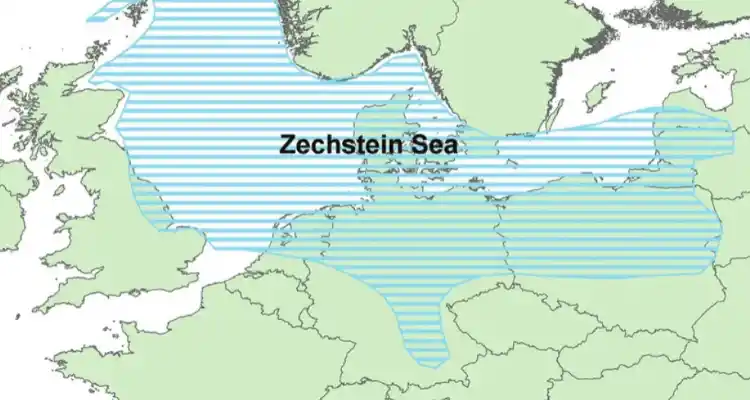
Long before there were oceans as we know them, before the continents had drifted into their current positions, and long before anything resembling a modern mammal walked the earth, a vast inland sea sat where the North Sea is today. Its slow, dramatic evaporation over millions of years left behind one of the purest mineral deposits on the planet — and it’s the source of the magnesium in every bottle of Zechsta.
The Short Answer
The Zechstein Sea was a large, shallow inland sea that existed roughly 257 to 251 million years ago during the Late Permian period, covering an area that stretched from eastern England across the modern North Sea into Germany and Poland. As the sea repeatedly evaporated under hot, arid conditions, it left behind thick layers of mineral-rich salt deposits — in places up to two kilometres thick — that have remained sealed deep underground ever since. Zechsta Magnesium is drawn from this ancient deposit, mined roughly two kilometres below the earth’s surface.
A Sea Unlike Any Around Today
To understand why this deposit is so unusual, it helps to picture the world as it was during the Late Permian period. The supercontinent Pangaea was just beginning to rift apart, and the region that would become the Zechstein Sea sat close to the equator, in the rain shadow of a mountain range far to the south. That combination — intense heat, low rainfall, and a largely enclosed basin — created conditions similar to today’s Persian Gulf: a shallow sea losing water to evaporation faster than it could be replenished.
Geologists describe the Zechstein Sea as a “saline giant” — a vast evaporating basin that filled and dried out in repeated cycles over millions of years. Each cycle concentrated the minerals left behind a little further, layer upon layer, until an extraordinarily pure and mineral-dense deposit had built up beneath what is now the North Sea and the surrounding lowlands of Britain, Germany, and Poland.
From Ancient Seabed to Sealed Time Capsule
As the Permian period gave way to later geological eras, these salt deposits were gradually buried beneath layer upon layer of sediment — eventually sitting roughly two kilometres beneath the earth’s surface. That burial turned out to be a fortunate accident of geological timing: sealed away from the surface, the deposit has remained untouched by millions of years of subsequent environmental change, agricultural runoff, industrial pollution, and modern contaminants.
In effect, the Zechstein Seabed functions like a geological time capsule — mineral-rich brine, preserved in the exact composition it settled into roughly 250 million years ago, long before human activity could have any influence on it.
Why the Age Matters
It’s easy to treat “200 million years old” as a marketing flourish, but the age is directly tied to the purity of what’s mined from it today. Modern seawater and modern soil are both subject to the effects of industrial activity, agricultural chemicals, and pollution that have built up over the last century. A deposit sealed two kilometres underground for a quarter of a billion years simply hasn’t been exposed to any of that. What’s extracted today reflects the mineral composition of that ancient sea, not the mineral composition of the modern world.
This is also part of why we’ve written about the difference between ancient, geologically sealed sources and modern-day extraction more broadly — see our related article on why where your magnesium comes from matters more than you think.
From Deposit to Bottle
Zechsta Magnesium is mined from this deposit roughly two kilometres below the earth’s surface and processed to preserve its natural mineral profile, rather than being synthetically manufactured in a lab. Our Zechsta Magnesium range, available as both magnesium oil and magnesium flakes, draws directly on this ancient source — offering a form of magnesium that’s been sitting in place since long before recorded history began.
Frequently Asked Questions
How old is the Zechstein Seabed deposit, exactly? The Zechstein Sea formed and evaporated in cycles roughly 257 to 251 million years ago, during the Late Permian period. The mineral deposits it left behind have remained sealed underground ever since.
Where is the Zechstein Seabed located? The ancient Zechstein Sea covered an area stretching from what is now eastern England, across the modern North Sea, and into Germany and Poland. The mineral deposits it left behind lie beneath this same broad region today.
Why does it matter that the deposit is sealed underground? Because it’s been buried roughly two kilometres beneath the surface for millions of years, the deposit has been protected from modern pollutants, agricultural runoff, and industrial contamination that affect surface-level and marine mineral sources today.
Is Zechstein Seabed magnesium different from regular sea salt or Epsom salt? Yes. While all of these ultimately originate from ancient or modern seawater, the Zechstein deposit’s age, depth, and isolation give it a distinct mineral profile and purity compared to modern sea salt or manufactured magnesium sulfate (Epsom salt).
The Takeaway
The story behind Zechsta Magnesium isn’t just an interesting piece of geological trivia — it’s the reason the product exists in the form it does. A quarter of a billion years of undisturbed preservation, sealed two kilometres beneath the earth, is not something that can be replicated or rushed. It’s simply a matter of the right sea, in the right place, at the right moment in the planet’s history.
Curious to experience magnesium with a 250-million-year head start? Explore our Zechsta Magnesium range and connect with one of the planet’s oldest, purest mineral sources.
This article is for educational purposes only and is not intended as medical advice. See our Medical Disclaimer for more information.
Sources
- Wikipedia. Zechstein. en.wikipedia.org/wiki/Zechstein
- The Geological Society. Zechstein Reefs, North Sea. geolsoc.org.uk
- Zhang, Y. et al. (2013). The Formation and Structure Evolution of Zechstein (Upper Permian) Salt in Northeast German Basin: A Review. ResearchGate.
