
Magnesium
Bathing in Wellness: The Science Behind Magnesium Flakes
Sep
Category: Magnesium Estimated reading time: 7 minutes
Bathing in Wellness: The Science Behind Magnesium Flakes
There’s something universally appealing about sinking into a warm bath after a long day. Add magnesium flakes to the water, and that simple ritual becomes something people reach for specifically — for tired muscles, restless minds, and dry, irritated skin. But what does the science actually say happens in that bath water?
The Short Answer
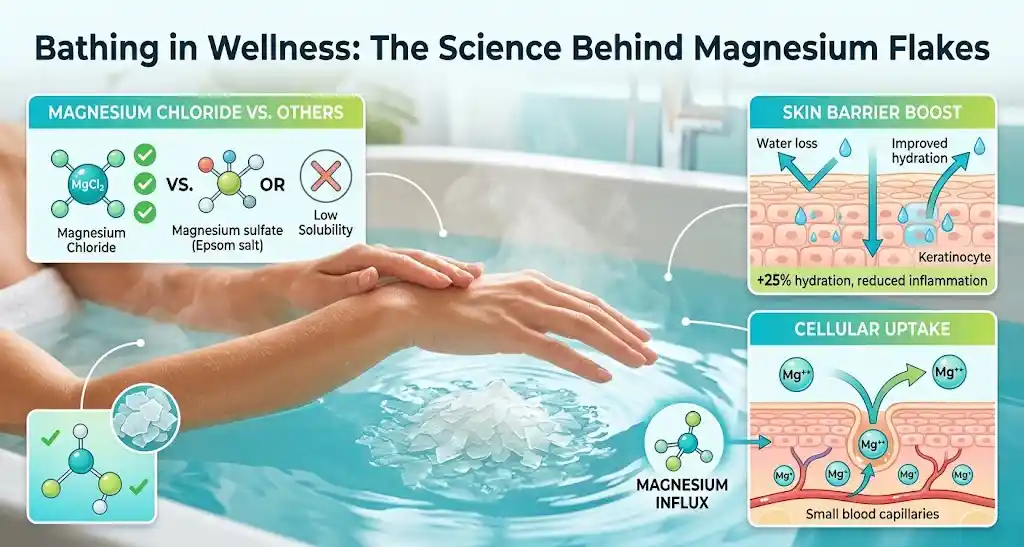
Magnesium flakes are magnesium chloride, a highly soluble mineral salt that dissolves quickly and completely in warm water. Clinical research on magnesium-rich bathing — most notably using Dead Sea salt solutions with a similar magnesium chloride profile — has found measurable improvements in skin barrier function, hydration, and inflammation in people with dry or irritated skin. Whether meaningful amounts of magnesium reach the bloodstream through bathing is a separate, less settled question, but the direct effects on skin health have real clinical backing.
Why Magnesium Flakes, Specifically
Not all bath salts are the same compound. Traditional Epsom salt is magnesium sulfate, while magnesium bath flakes are magnesium chloride — a different pairing of magnesium with a different partner ion entirely. The distinction matters for a few practical reasons:
Solubility. Magnesium chloride dissolves more completely and quickly in water than magnesium sulfate, meaning less residue and a more consistent concentration throughout your bath.
Concentration. Magnesium chloride flakes generally contain a higher proportion of elemental magnesium by weight than Epsom salt, so less product is needed to reach a comparable magnesium concentration in the water.
Skin feel. Many people find magnesium chloride gentler and less drying on the skin compared to magnesium sulfate, which can leave a tighter, drier feeling after longer soaks.
What the Research Actually Shows
The strongest clinical evidence in this space comes from studies using Dead Sea salt, which is naturally rich in magnesium chloride. A randomized, double-blind clinical trial examined people with atopic (eczema-prone) dry skin, having them submerge one forearm in a magnesium-rich Dead Sea salt solution and the other in plain tap water as a control. After six weeks, the magnesium-treated skin showed meaningfully reduced water loss through the skin barrier, improved hydration, and reduced roughness and inflammation compared to the control.
A more recent clinical review examining magnesium’s broader role in dermatology found that magnesium influences several processes relevant to skin health, including keratinocyte (skin cell) proliferation, collagen synthesis, and barrier repair, with preliminary evidence pointing to potential benefits for conditions like atopic dermatitis and general dry skin. The same review was careful to note that available clinical studies in this area tend to be small, and more robust research is still needed.
What About Absorption Into the Body?
This is where the science becomes more debated. While magnesium clearly interacts with the skin in ways that measurably improve hydration and barrier function, exactly how much magnesium passes through the skin into the bloodstream during a bath is less well established, and it’s an area where reputable researchers hold differing views. We’ve covered this broader question in more detail in why transdermal magnesium outperforms oral supplements, including where the evidence is strongest and where it remains open.
What’s not in question is that a warm magnesium flake bath has a long history of use for relaxation and muscle relief, and the direct skin-level benefits — hydration, barrier support, and reduced skin inflammation — are backed by genuine clinical research, independent of the absorption debate.
Making the Most of a Magnesium Flake Bath
If you’re using magnesium flakes as part of your routine, a few practical points can help:
- Use warm, not scalding, water — very hot water can be drying to the skin regardless of what’s dissolved in it.
- Soak for at least 15–20 minutes to allow time for the mineral solution to interact meaningfully with the skin, based on the timeframes used in clinical research.
- Moisturise afterward to help lock in the hydration benefits, particularly if your skin tends to be dry.
- Be consistent — the clinical improvements in skin barrier function were observed after six weeks of regular use, not a single soak.
A Naturally Sourced Option
Our Zechsta Magnesium range is sourced from the Zechstein Seabed, a mineral deposit formed roughly 200 million years ago and preserved deep underground — offering a naturally pure magnesium chloride source, whether used as a topical application or added to your bathing routine.
Frequently Asked Questions
What’s the difference between magnesium flakes and Epsom salt? Magnesium flakes are magnesium chloride; Epsom salt is magnesium sulfate. Magnesium chloride dissolves more completely, is generally gentler on skin, and contains a higher proportion of elemental magnesium by weight.
Does bathing in magnesium flakes actually improve my skin? Clinical research on magnesium-rich bathing, particularly using Dead Sea salt solutions, has shown measurable improvements in skin hydration, barrier function, and inflammation in people with dry or irritated skin after several weeks of regular use.
Will a magnesium flake bath raise my magnesium levels in the blood? This is less certain than the skin-level benefits. Some research suggests skin absorption is possible, but the exact amount that reaches the bloodstream through bathing specifically is still debated among researchers, and more rigorous studies are needed.
How often should I take a magnesium flake bath to see results? Clinical studies showing skin improvements used consistent bathing over roughly six weeks, so a single bath is unlikely to show dramatic changes — think of it as a routine to build rather than a one-time fix.
The Takeaway
Whatever the final answer on systemic absorption turns out to be, magnesium flakes have real, clinically documented benefits for skin health and hydration — and a long history of use for relaxation that most people don’t need a study to appreciate. Sometimes the science backs up exactly what your body has been telling you all along.
Ready to bring the science of magnesium flakes into your routine? Explore our Zechsta Magnesium range and experience it for yourself.
This article is for educational purposes only and is not intended as medical advice. If you have a skin condition or sensitivity, please consult your doctor or dermatologist before starting a new bathing routine. See our Medical Disclaimer for more information.
Sources
- Proksch, E., Nissen, H.P., Bremgartner, M., Urquhart, C. (2005). Bathing in a magnesium-rich Dead Sea salt solution improves skin barrier function, enhances skin hydration, and reduces inflammation in atopic dry skin. International Journal of Dermatology, 44(2), 151–157.
- The role of magnesium in dermatology (2025). ScienceDirect, Clinical Review. sciencedirect.com
- Gröber, U., Werner, T., Vormann, J., Kisters, K. (2017). Myth or Reality—Transdermal Magnesium? Nutrients, PMC. ncbi.nlm.nih.gov
