
Magnesium
The Absorption Problem: Why Most Magnesium Supplements Fail You
Aug
Category: Magnesium Estimated reading time: 8 minutes
You bought the supplement. You took it every day. And weeks later, you feel… about the same. If that’s happened to you, you’re not imagining it, and you’re not doing anything wrong. The uncomfortable truth is that absorption, not intake, is where most magnesium supplementation quietly falls apart — and it happens in more ways than most labels let on.
The Short Answer
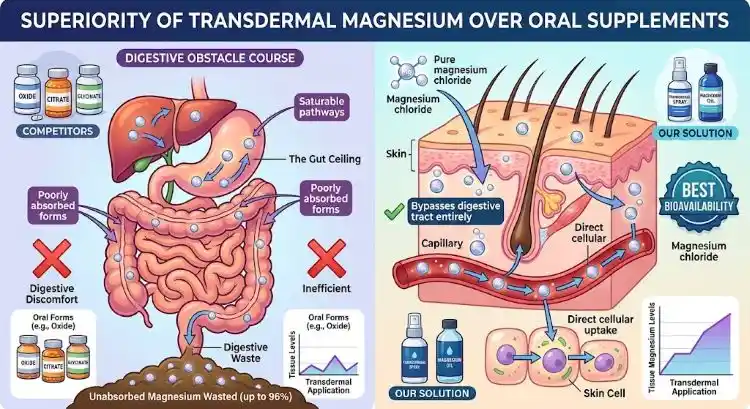
Taking a magnesium supplement doesn’t guarantee your body absorbs a meaningful amount of it. Absorption is affected by which form of magnesium you take, how large a single dose is, what else is in your gut at the time, and even your body’s own regulatory mechanisms. Research shows magnesium absorption relies on both a saturable and a non-saturable pathway in the gut — meaning there’s a practical ceiling on how much your intestines can absorb from a single dose, no matter how much elemental magnesium the label promises.
Problem One: Your Gut Has a Absorption Ceiling
Magnesium absorption in the small intestine happens through two different pathways: a high-capacity pathway that isn’t easily overwhelmed, and a separate, saturable pathway that handles smaller loads — generally magnesium doses below roughly 125–250 mg at a time. Once that saturable pathway is maxed out, additional magnesium in the same dose is absorbed far less efficiently, regardless of the total amount you swallowed.
This is a big part of why a single large dose of magnesium is generally less effective than the same total amount split across two or three smaller doses throughout the day — your gut simply isn’t built to process a big influx all at once.
Problem Two: What Else Is in Your Gut Matters
Magnesium doesn’t exist in isolation in your digestive tract — it interacts with whatever else you’ve eaten. Research has found that phytate, a compound found in whole grains, legumes, nuts, and seeds, can reduce magnesium absorption by as much as 60% in a dose-dependent manner, likely by binding to magnesium and preventing it from being absorbed in the small intestine.
Interestingly, not everything works against magnesium. Fermentable dietary fibers, such as fructo-oligosaccharides found in foods like onions, garlic, and bananas, have been shown to increase magnesium absorption in humans by 10–25%. This is a good reminder that “more fiber” isn’t a uniformly simple rule — the type of fiber matters.
Problem Three: The Form You Choose
As we covered in more detail in skin deep: how magnesium oil bypasses digestive limitations, the compound magnesium is bound to in a supplement dramatically affects how much of it your body can actually use. Poorly soluble forms like magnesium oxide have shown fractional absorption as low as roughly 4% in controlled research, meaning the vast majority of a typical oxide dose passes straight through undigested.
Problem Four: Your Kidneys Are Quietly Adjusting Too
Absorption isn’t the only checkpoint. Once magnesium is absorbed, your kidneys play an active role in deciding how much to retain versus excrete in urine, based on your current magnesium status. This is actually a well-designed system for maintaining balance — but it also means simply “taking more” doesn’t linearly translate into “having more,” since your body will excrete what it judges to be surplus once your tissue stores are reasonably replete.
Why This Matters for You
None of this means magnesium supplementation doesn’t work — it clearly can, for the right form, at the right dose, taken the right way. But it explains why so many people take a supplement, see no noticeable change, and conclude that “magnesium doesn’t do anything for me.” In most of these cases, the issue isn’t the mineral — it’s an absorption pathway working against a supplement that wasn’t set up to work with it.
How to Actually Improve Your Absorption
A few practical, evidence-informed adjustments can make a real difference:
- Split larger doses. Taking magnesium in two or three smaller servings throughout the day, rather than one large dose, works with your gut’s saturable absorption pathway rather than against it.
- Be mindful of timing around high-phytate meals. Taking a supplement away from very high-phytate meals (like a large serving of raw bran or legumes) may modestly improve absorption, though normal balanced meals aren’t generally a major concern.
- Choose a better-absorbed form. Forms like citrate and glycinate are consistently better absorbed than oxide in research, and cause fewer digestive side effects at effective doses.
- Consider a transdermal option. Because it doesn’t rely on gut absorption at all, transdermal magnesium sidesteps the saturable-pathway and dietary-interaction issues entirely — worth exploring if oral forms haven’t worked well for you.
A Different Route to the Same Goal
Given how many variables affect oral absorption, many people choose to support their magnesium levels transdermally instead, avoiding the gut altogether. Our Zechsta Magnesium range is sourced from the Zechstein Seabed, a mineral deposit formed roughly 200 million years ago and preserved deep underground, offering a naturally pure magnesium chloride solution applied directly to the skin.
Frequently Asked Questions
Why did my magnesium supplement not seem to do anything? There are several possible reasons: a poorly absorbed form like oxide, a single large dose exceeding your gut’s saturable absorption capacity, dietary factors like high phytate intake reducing absorption, or simply needing more time and consistency. It’s rarely a sign that magnesium itself “doesn’t work” for you.
Is it better to split my magnesium dose throughout the day? Research on the gut’s saturable absorption pathway suggests yes — splitting larger total doses into two or three smaller servings works with your body’s absorption limits rather than against them, particularly for doses above roughly 125–250 mg at once.
Does fiber help or hurt magnesium absorption? It depends on the type. Phytate, found in whole grains and legumes, can meaningfully reduce absorption. Fermentable fibers, like those found in onions, garlic, and bananas, have been shown to improve it. It isn’t a simple “more fiber is better” or “worse” rule.
Will taking a higher dose make up for poor absorption? Not reliably. Because magnesium absorption relies partly on a saturable pathway, and your kidneys regulate how much magnesium your body retains, simply increasing the dose of a poorly absorbed form often just increases digestive side effects rather than proportionally increasing what your body actually uses.
The Takeaway
Magnesium supplementation isn’t as simple as “take it and you’re covered.” Absorption depends on the form, the dose, what else is in your gut, and your body’s own regulatory systems — and most supplement labels don’t tell you any of that. Understanding the real absorption problem is the first step to actually solving it.
Looking for a way to support your magnesium levels without the absorption guesswork? Explore our Zechsta Magnesium range and take the digestive variables out of the equation.
This article is for educational purposes only and is not intended as medical advice. If you have concerns about your magnesium levels or supplement routine, please consult your doctor. See our Medical Disclaimer for more information.
Sources
- Schuchardt, J.P., Hahn, A. (2017). Intestinal Absorption and Factors Influencing Bioavailability of Magnesium — An Update. Current Nutrition & Food Science. Luxembourg Institute of Health
- Coudray, C. et al. (2003). Effects of Dietary Fibers on Magnesium Absorption in Animals and Humans. The Journal of Nutrition, ScienceDirect. sciencedirect.com
- Firoz, M., Graber, M. (2001). Bioavailability of US commercial magnesium preparations. Magnesium Research, 14(4), 257–262.
