
Magnesium
Why Modern Soil Can No Longer Feed Your Magnesium Needs
Jul
Category: Magnesium Estimated reading time: 6 minutes
Your grandparents could eat a plate of vegetables and get a meaningful dose of magnesium. You can eat the same plate today and get a fraction of that amount — even if the vegetables look identical.
This isn’t about eating habits. It’s about what’s happening — or not happening — in the soil those vegetables grow in. And it’s one of the most overlooked reasons magnesium deficiency has become so widespread.
The Nutrient Decline Nobody Talks About
Over the past several decades, agricultural researchers have documented a measurable decline in the mineral content of fruits and vegetables, magnesium included. The food on our plates hasn’t changed in appearance, but its nutritional density has quietly dropped generation after generation.
This phenomenon even has a name: nutrient dilution. As crops are bred and farmed to grow bigger, faster, and more resistant to pests, they often dilute the minerals and nutrients within each bite — including magnesium.
Why Soil Runs Out of Magnesium
Healthy soil is a living, mineral-rich ecosystem. But several modern farming practices are steadily stripping it of what it needs to nourish crops properly.
Intensive, repeated cropping. Land that once rested between harvests is now farmed continuously, with little time for minerals to naturally replenish.
Synthetic fertilizers. Conventional fertilizers are typically formulated to boost nitrogen, phosphorus, and potassium — the nutrients that drive visible plant growth — while paying little attention to magnesium and other trace minerals.
Soil erosion. Wind, water, and poor land management wash away topsoil, the very layer where most minerals are concentrated.
Reduced organic matter. Fewer cover crops, less crop rotation, and heavier reliance on chemical inputs all reduce the organic matter that helps soil hold and cycle minerals effectively.
The result: crops grow, but the soil feeding them is increasingly mineral-poor — and so is the food it produces.
What This Means for Your Health
Magnesium is involved in hundreds of processes in the human body, from energy production to muscle function to nervous system regulation. When the food supply itself contains less of it, it becomes harder to meet daily needs through diet alone — no matter how many vegetables end up on your plate.
This helps explain why magnesium deficiency is so common even among people who consider themselves to be eating healthily. It’s not a failure of effort. It’s a shift in what “healthy food” actually contains.
Can You Still Get Enough Magnesium From Food?
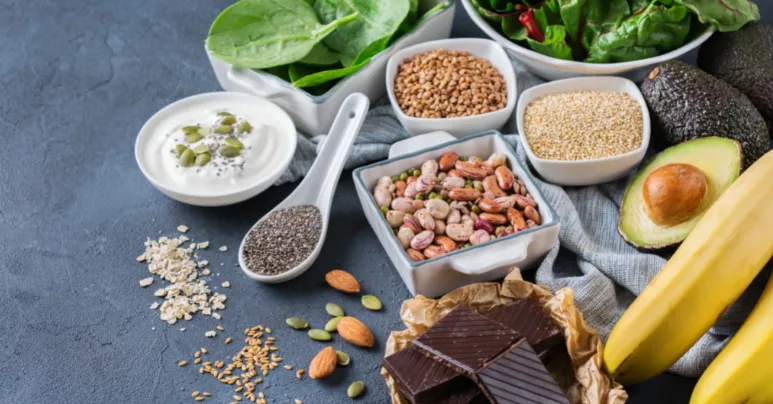
Yes — magnesium-rich foods are still worth prioritizing, and should remain the foundation of any healthy diet. Leafy greens, nuts, seeds, legumes, and whole grains all contribute meaningfully to your intake.
But given the decline in soil quality, many people find it difficult to consistently reach optimal magnesium levels through food alone — particularly if they also face other magnesium-draining factors like stress, caffeine, or physical activity.
Closing the Gap Naturally
This is where sourcing matters. At Suncore, our Zechsta Magnesium comes not from modern topsoil, but from the Zechstein Seabed — a mineral deposit formed roughly 200 million years ago and sealed deep underground, long before industrial farming, fertilizers, or pollution existed. It’s magnesium in one of its purest, most untouched natural forms, applied transdermally to support absorption without relying on depleted soil or an already-taxed digestive system.
Frequently Asked Questions
Is it true that vegetables have less magnesium than they used to? Multiple long-term studies comparing food composition data across decades have documented declines in the mineral content of fruits and vegetables, including magnesium — a pattern often called the “dilution effect.” It’s worth noting that some researchers debate exactly how large the decline is, since older and newer data aren’t always measured the same way, but the broad direction of the trend is well documented.
Why does soil lose magnesium over time? Intensive, continuous cropping, synthetic fertilizers that prioritize nitrogen, phosphorus, and potassium over trace minerals, soil erosion, and reduced organic matter all contribute to soil gradually holding less magnesium — which means the crops grown in it absorb less too.
Does organic produce have more magnesium? Not necessarily. Soil mineral depletion is influenced more by decades of farming intensity and crop breeding for yield than by whether a farm is certified organic, so “organic” alone isn’t a guarantee of higher magnesium content.
If food has less magnesium, how can I make up the difference? Prioritizing magnesium-rich foods like leafy greens, legumes, nuts, and seeds is still the right foundation. Many people also use a naturally sourced magnesium supplement to help close the gap that modern soil and food processing can leave behind.
The Takeaway
Modern soil is doing its best, but decades of intensive farming have left it — and the food it produces — measurably poorer in magnesium than it once was. Understanding this is the first step to closing the gap: eat magnesium-rich foods as a foundation, stay aware of factors that increase your body’s magnesium needs, and consider a high-quality, naturally sourced supplement to help fill in the rest.
Want to top up what modern soil can no longer provide? Explore our Zechsta Magnesium range, sourced from a mineral deposit untouched for 200 million years.
This article is for educational purposes only and is not intended as medical advice. If you are experiencing persistent symptoms, please consult your doctor or healthcare provider before starting any new supplement. See our Medical Disclaimer for more information.
Sources
Marles, R.J. (2017). Mineral nutrient composition of vegetables, fruits and grains: The context of reports of apparent historical declines. Journal of Food Composition and Analysis. sciencedirect.com
Davis, D.R. et al. (2004). Changes in USDA Food Composition Data for 43 Garden Crops, 1950 to 1999. Journal of the American College of Nutrition. Summarized via Eartheasy
An Alarming Decline in the Nutritional Quality of Foods: The Biggest Challenge for Future Generations’ Health (2024). PMC. ncbi.nlm.nih.gov
