
Magnesium
Transdermal vs. Oral Magnesium: What the Research Says
Sep
Category: Magnesium Estimated reading time: 9 minutes
By now, if you’ve read a few of our other articles, you’ll know that both transdermal and oral magnesium have real research behind them — and real gaps in that research too. Rather than picking a side, this piece pulls it all together: what’s actually been studied, what’s still debated, and how the two approaches stack up when you put them side by side.
The Short Answer
Oral magnesium has decades of well-established research behind its absorption, with clear data showing that absorption varies significantly by form — from as low as roughly 4% for magnesium oxide to considerably higher for citrate and glycinate — and that oral forms are limited by gut saturation and gastrointestinal side effects at higher doses. Transdermal magnesium is designed to avoid those digestive limitations entirely, and there’s genuine, if smaller and more contested, research suggesting magnesium can be absorbed through the skin. Neither approach is without an evidence gap — the honest picture is a trade-off, not a clear winner.
At a Glance
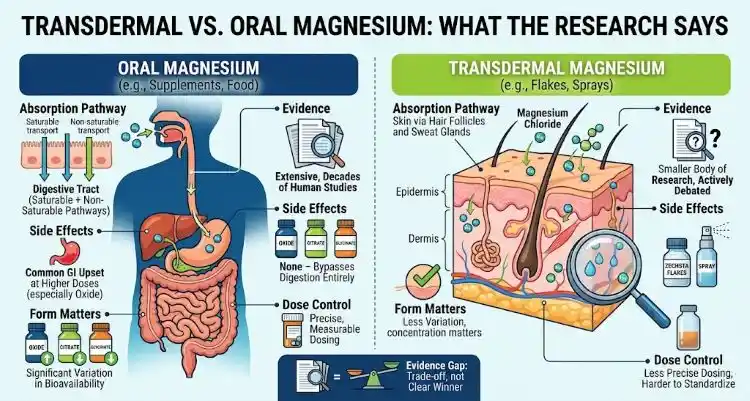
| Oral Magnesium | Transdermal Magnesium | |
|---|---|---|
| Absorption pathway | Digestive tract (saturable + non-saturable pathways) | Skin, primarily via hair follicles and sweat glands |
| Absorption evidence | Extensive, decades of controlled human studies | Smaller body of research, actively debated by scientists |
| Digestive side effects | Common at effective doses, especially with oxide | None — bypasses digestion entirely |
| Form matters | Significantly — oxide vs. citrate vs. glycinate vary widely | Less variation, though concentration and formulation still matter |
| Best documented use | Correcting confirmed dietary deficiency | Muscle relaxation, skin hydration, avoiding GI upset |
| Dose control | Precise, measurable per tablet or capsule | Less precise, harder to standardize exact intake |
What the Research Says About Oral Magnesium
Oral supplementation is the more thoroughly studied of the two approaches. Researchers have directly measured absorption rates for different forms using controlled human trials, and the findings are consistent: magnesium oxide is poorly absorbed, with some studies showing fractional absorption as low as around 4%, while forms like citrate and glycinate perform considerably better.
The trade-off is digestive tolerance. Better-absorbed forms still carry some risk of digestive discomfort at higher doses, and oral absorption is also capped by a saturable gut pathway — meaning very large single doses are absorbed less efficiently than the same total amount split across the day. We cover this in detail in the absorption problem: why most magnesium supplements fail you.
What the Research Says About Transdermal Magnesium
The transdermal side of the research is smaller, newer, and more contested. Much of the popular case for transdermal magnesium traces back to a small, frequently cited study from the University of Birmingham, in which participants soaked in a warm magnesium sulfate bath daily for a week and showed increased blood magnesium levels afterward. However, a widely referenced 2017 scientific review examining transdermal magnesium evidence specifically criticized this and similar early studies for methodological limitations, and concluded that current evidence does not scientifically establish transdermal magnesium absorption as an effective route to correct deficiency.
That said, the same review — and others since — acknowledge that magnesium, like other metallic ions, can penetrate the skin’s outer barrier to some degree, primarily through hair follicles and sweat glands. Separate, smaller pilot studies measuring serum and urinary magnesium after topical cream application have shown modest upward trends, though sample sizes have generally been small. Independent of the absorption debate, clinical research on magnesium-rich bathing has also shown clear, well-documented benefits for skin hydration and barrier function, which we cover in bathing in wellness: the science behind magnesium flakes.
So Which One Should You Choose?
Rather than “which one is scientifically superior,” the more useful question is which trade-offs work better for you:
Choose oral magnesium if:
- You want a precisely measurable, well-researched dose
- You tolerate citrate or glycinate forms without digestive discomfort
- You’re working with a doctor to correct a confirmed deficiency
Choose transdermal magnesium if:
- Oral forms cause digestive upset, even well-tolerated ones
- You want to apply magnesium directly to areas of muscle tension
- You prefer not to add another daily pill to your routine
- You’re drawn to the relaxation and skin-hydration benefits of magnesium bathing, independent of the absorption question
Consider combining both if:
- You want the measurable dosing of oral magnesium alongside the practical, digestion-free benefits of topical use
Being Honest About What We Don’t Know Yet
It’s tempting for any single source, ours included, to present a clean, confident answer. But the fair, evidence-based picture is this: oral magnesium’s absorption science is well established but comes with a real digestive trade-off, while transdermal magnesium avoids that trade-off but with a thinner, more debated evidence base for how much magnesium it actually delivers into the bloodstream. Both approaches have legitimate research behind their direct, observable benefits — muscle relaxation, skin health, and avoiding GI side effects — even where the deeper absorption questions remain open.
A Naturally Sourced Option, Either Way
Whichever approach fits your needs, sourcing still matters. Our Zechsta Magnesium range is drawn from the Zechstein Seabed, a mineral deposit formed roughly 200 million years ago and preserved deep underground, offering a naturally pure magnesium chloride source for topical use as part of a broader, balanced approach to your magnesium intake.
Frequently Asked Questions
Is transdermal magnesium proven to be as effective as oral magnesium? No single study has definitively settled this comparison. Oral magnesium’s absorption is well documented but comes with digestive trade-offs depending on the form. Transdermal magnesium avoids those trade-offs but has a smaller, more contested body of absorption research. Reputable sources are honest that this remains an open scientific question.
Why do some scientists doubt transdermal magnesium absorption? A widely cited 2017 review pointed out that early studies supporting transdermal absorption had methodological limitations, and that hair follicles and sweat glands — the likely entry points for topical magnesium — cover only a small fraction of total skin surface area, raising questions about how much magnesium can realistically be absorbed this way.
Can I use both oral and transdermal magnesium together? Many people do combine both as part of a broader approach, particularly if they want the measurable dosing of an oral supplement alongside the practical, digestion-free benefits of a topical product. Speak to your doctor if you’re taking other medications or supplements.
Which is better for muscle cramps specifically — oral or transdermal? Both are used for this purpose, though there’s more direct research on oral magnesium’s role in muscle and nerve function generally. Some people find applying magnesium directly to a cramping muscle provides a more immediate, localized sense of relief, though this is more anecdotal than clinically proven.
The Takeaway
The transdermal-versus-oral debate isn’t really a contest with a declared winner — it’s two different approaches with different strengths, different trade-offs, and different gaps in the evidence. The most honest advice is to understand both, and choose based on what actually works for your body and your routine.
Curious about adding a natural transdermal option to your routine? Explore our Zechsta Magnesium range and decide what works best for you.
This article is for educational purposes only and is not intended as medical advice. If you have concerns about magnesium absorption or supplementation, please consult your doctor or healthcare provider. See our Medical Disclaimer for more information.
Sources
- Gröber, U., Werner, T., Vormann, J., Kisters, K. (2017). Myth or Reality—Transdermal Magnesium? Nutrients, PMC. ncbi.nlm.nih.gov
- Waring, R.H. Report on Absorption of Magnesium Sulfate (Epsom Salts) Across the Skin. School of Biosciences, University of Birmingham.
- Firoz, M., Graber, M. (2001). Bioavailability of US commercial magnesium preparations. Magnesium Research, 14(4), 257–262.
